How Intelligent Tools Are Enhancing Developer Productivity
The integration of AI-powered features into modern Integrated Development Environments (IDEs) is revolutionizing how developers write, review, and debug code. Tools like Google’s Gemini Code Assist, JetBrains AI Assistant, and others embedded in popular IDEs such as Visual Studio Code and IntelliJ are making coding faster, smarter, and more efficient.
AI-Powered Features in Today’s IDEs
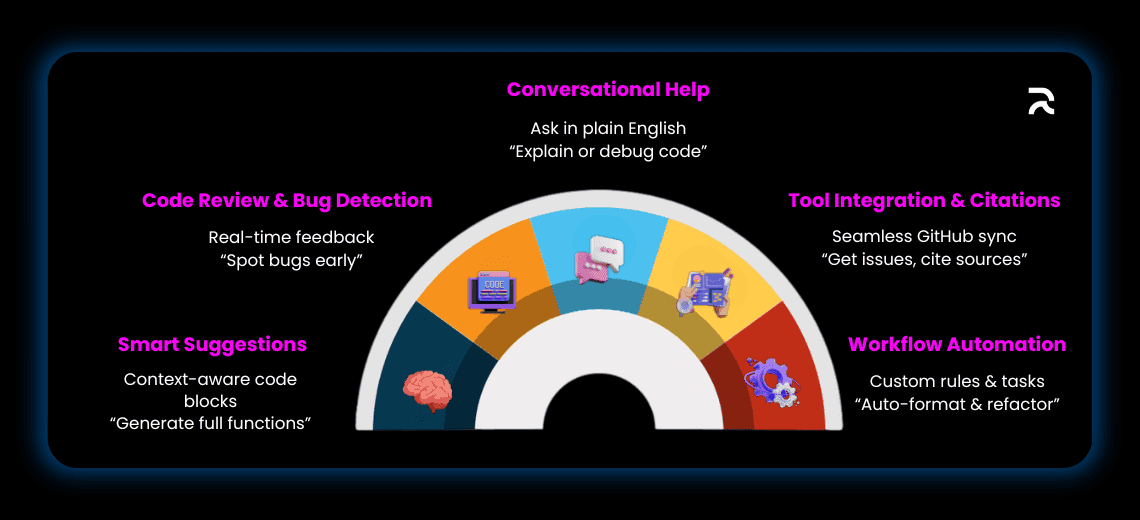
1. Smart Code Suggestions and Auto-Completion
AI assistants provide real-time, context-aware code completions that go beyond simple syntax hints. For example, Google’s Gemini Code Assist, which uses Google’s Gemini models, offers smarter suggestions by understanding the broader code context, enabling it to generate entire functions or code blocks from comments or prompts. Similarly, JetBrains AI Assistant uses its Mellum large language model to deliver fast, accurate, and syntax-aware completions across languages like Java, Python, Kotlin, and more. JetBrains’ free tier covers Mellum-powered completions, while cloud features such as chat and agents draw on a credit allowance.
2. Automated Code Reviews and Bug Detection
AI tools embedded in IDEs can automatically review code as it is written, flagging potential bugs, security vulnerabilities, or style inconsistencies. Gemini Code Assist includes a sharpened GitHub code review agent that spots issues early in the development cycle. JetBrains AI Assistant can identify potential bugs and suggest optimizations on the fly, helping maintain code quality without interrupting workflow. Beyond the IDE, Gemini Code Assist for GitHub can review pull requests directly: commenting /gemini review requests a review, /gemini summary summarizes the changes, and a repository style guide shapes what the reviewer flags.
3. Conversational AI Assistance
Developers can interact with AI chat assistants directly within their IDEs, asking questions about their code, requesting explanations for complex logic, or getting help with debugging. Gemini Code Assist supports multi-file context, allowing developers to include entire folders in prompts and manage multiple chat sessions seamlessly. JetBrains AI Assistant offers a natural language chat interface tailored to the specific project and programming language.
4. Custom Commands and Workflow Automation
Gemini Code Assist now supports Custom Commands and Rules, enabling teams to automate repetitive tasks and enforce project style guides consistently. This feature accelerates routine operations, such as formatting, refactoring, or applying coding standards, directly within the IDE. In VS Code, open the Gemini Code Assist Quick Pick menu (Ctrl+I on Windows and Linux, Cmd+I on macOS) and choose Custom Commands. In JetBrains IDEs, the equivalent is Settings > Tools > Gemini > Prompt Library. Rules work differently: once added in the Rules settings, Gemini Code Assist considers them for every prompt, which suits conventions such as mandatory unit tests.
5. Integration with External Tools and Source Citation
AI assistants can pull information and perform actions from external services like GitHub, enabling developers to fetch assigned issues or repository data without leaving the IDE. Additionally, Gemini Code Assist provides source citations when quoting or generating code from external repositories, helping developers comply with licensing and intellectual property requirements.
6. Agent Mode for Multi-Step Tasks
Chat answers one question at a time, while agent mode works toward a goal. In Gemini Code Assist, agent mode can plan a multi-step task, use system tools and Model Context Protocol (MCP) servers, and present its changes for the developer to review before they are applied. JetBrains offers a comparable agent called Junie, which works through larger tasks step by step inside the IDE. In both cases the developer stays in the loop, so agent output deserves the same review as any teammate’s pull request.
Tips to Maximize AI Tools While Maintaining Code Quality and Security
-
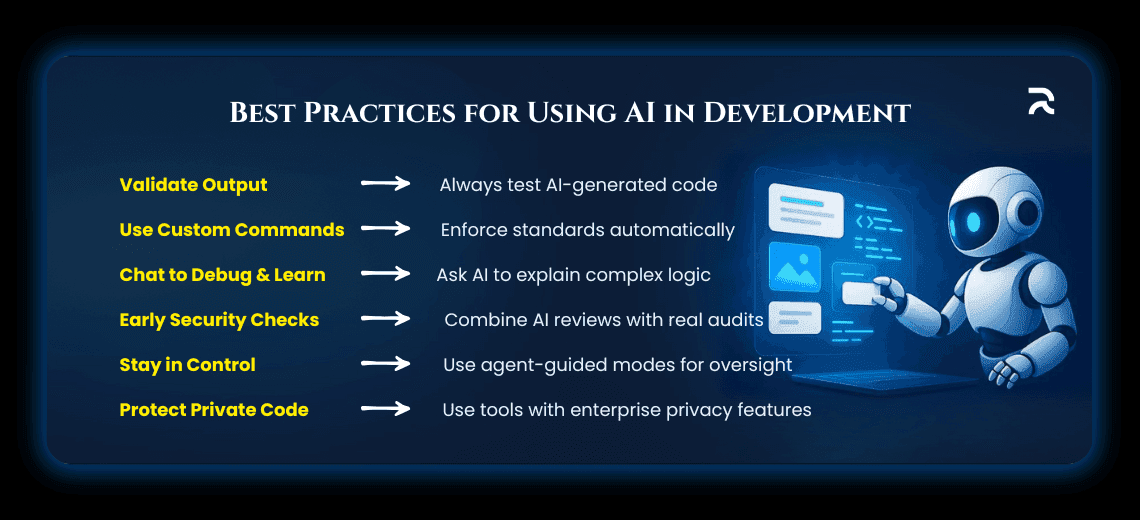
Validate AI-Generated Code: AI outputs can sometimes be plausible but incorrect. Always review and test generated code thoroughly before deployment.
-
Leverage Custom Commands for Consistency: Use features like Gemini’s Custom Commands to enforce coding standards and reduce manual oversight.
-
Use Conversational AI for Learning and Debugging: Engage with AI chat assistants to understand confusing code sections, which can speed up onboarding and troubleshooting.
-
Integrate Security Checks Early: Utilize AI’s bug detection and code review capabilities to catch vulnerabilities early, but complement this with dedicated security audits.
-
Maintain Control with Agentic Modes: Tools like JetBrains AI Assistant offer modes where developers guide AI through complex tasks, ensuring human oversight over automated changes.
-
Keep Sensitive Code Private: For enterprise environments, use AI tools that support private codebase integration and comply with data privacy standards, such as Gemini Code Assist Enterprise.
Where AI Coding Assistants Still Fall Short
These tools save time, but they do not remove the need for judgment. Generated code, AI reviews and agent edits all still need human validation before they reach production. Features also depend on the plan: advanced capabilities such as agent mode can require a paid tier, and vendors change editions, models and pricing often, so check the current documentation before standardizing a team on one tool. Finally, an assistant only knows the context it is given. If a prompt or repository lacks the relevant files or conventions, even a strong model can produce code that compiles but does not fit the project.
Conclusion
AI-powered features embedded in modern IDEs are transforming software development by enhancing productivity, improving code quality, and reducing cognitive load on developers. From smart code completions and automated reviews to conversational assistants and workflow automation, these intelligent tools are becoming indispensable collaborators in the coding process. By thoughtfully integrating and managing AI assistance, developers can unlock new levels of efficiency and innovation while maintaining high standards of code quality and security.
This new era of AI-enhanced IDEs is not just about faster coding — it’s about smarter, more reliable, and more enjoyable software development.
The same pattern applies outside the IDE. Traders who write Pine Script face the same trade-off between speed and correctness, which is why reviewing and testing AI-generated code matters there too. For a practical comparison, see Pine Script AI vs manual coding.
Start Building TradingView Strategies with PineGen AI Today
Turn trading ideas into validated strategies with AI