
Best Pine Script AI Tools in 2026: PineGen AI vs Pineify vs Pine Script wizard vs RoboQuant

The Moment Things Stop Making Sense
You generate a strategy using AI.
-
It compiles.
-
Signals look clean.
-
Backtest shows profit.
Then you try it in forward testing.
Something feels off.
-
Entries don’t trigger the same way.
-
Exits behave differently.
-
Performance slowly breaks down.
That’s when most traders realize:
-
Writing Pine Script isn’t the problem anymore.
-
Building something that behaves correctly is.
1. The Hidden Gap Most People Don’t Notice
There are two layers to every Pine Script strategy:
- Code generation → syntax, structure
- Execution behavior → how it performs inside TradingView
Most AI tools solve the first layer. Very few understand the second.
And that’s why, strategies compile but don’t hold up in testing.
This case study looks at four tools, PineGen AI, Pineify, Pine Script Wizard, and RoboQuant, from that exact perspective.
2. What We Actually Tested
Instead of random prompts, each tool was given the same structured request:
Build an EMA crossover strategy with ATR-based stop-loss, take-profit, commission, slippage, and a higher timeframe trend filter. Nothing extreme. Just something real.
The goal wasn’t speed.
It was which tool produces something closest to a usable strategy?
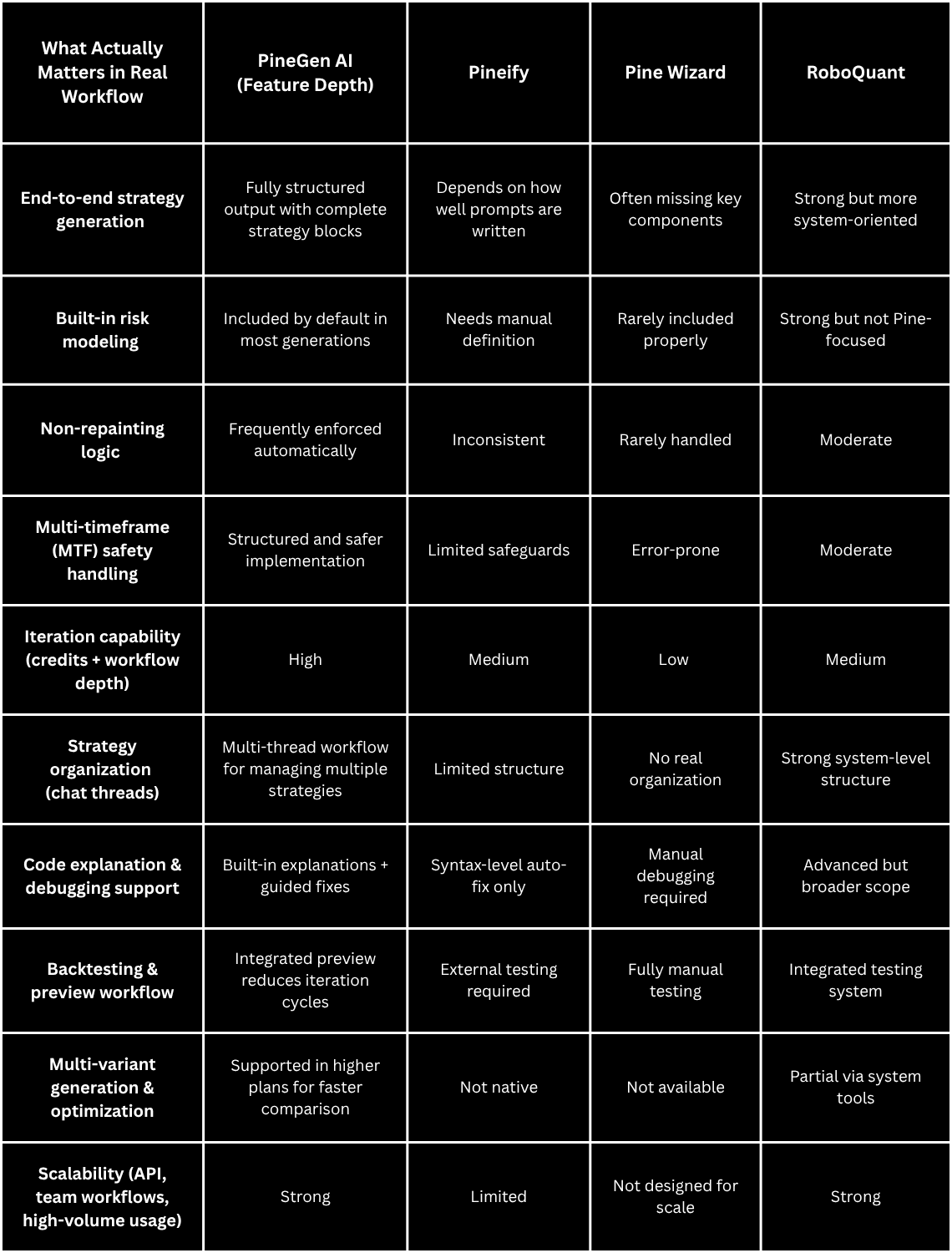
3. PineGen AI - Where Strategy Building Starts to Feel Structured
The first noticeable difference isn’t just the code, it’s how complete everything feels.
Instead of generating fragments, PineGen AI builds:
-
properly initialized strategy blocks
-
connected entry and exit logic
-
risk handling tied to market conditions
But what actually makes it stand out is how its features support real workflows, not just generation.
3.1 Features That Actually Change the Workflow
3.1.1 Credits → Enable Iteration, Not Just Usage
With higher plans:
-
you can test multiple variations
-
adjust parameters repeatedly
-
refine strategies step-by-step
This matters because:
- strategies improve through iteration, not first attempts
Without enough credits, you stop early. With them, you actually develop the idea.
3.1.2 Chat Threads → Turn Ideas Into Organized Systems
Instead of mixing everything:
-
each strategy gets its own thread
-
you can track improvements clearly
-
revisit and refine older setups
At scale, this becomes:
- managing strategies, not just creating them
3.1.3 Prompt Builder → Reduces Guesswork
Instead of vague prompts, you define:
-
indicators
-
entry logic
-
exit conditions
-
risk rules
This leads to:
-
better first outputs
-
fewer wasted attempts
3.1.4 Code Explanation & Debugging → Cuts Down Friction
Instead of guessing:
-
you understand why something failed
-
you fix logic faster
-
you improve your own knowledge
Over time:
-
less trial-and-error
-
more intentional refinement
3.1.5 Backtesting & Preview → Shorter Feedback Loop
You don’t have to constantly switch tools.
-
test logic faster
-
catch structural issues early
-
reduce unnecessary cycles
Multi-Variant Generation & Optimization
-
Instead of testing one idea at a time:
-
generate multiple variations
-
compare performance
-
refine aggressively
This is where strategy building becomes systematic
3.2 Advanced Capabilities (Higher Plans)
-
API access → integrate into custom workflows
-
team workspaces → collaborate on strategies
-
real-time strategy discovery → adapt to current conditions
-
multi-source intelligence → combine multiple inputs
This moves PineGen AI from a tool to something closer to infrastructure.
3.3 What This Means in Practice
Instead of:
generate → fix → rewrite → repeat
You move into:
generate → refine → optimize → scale
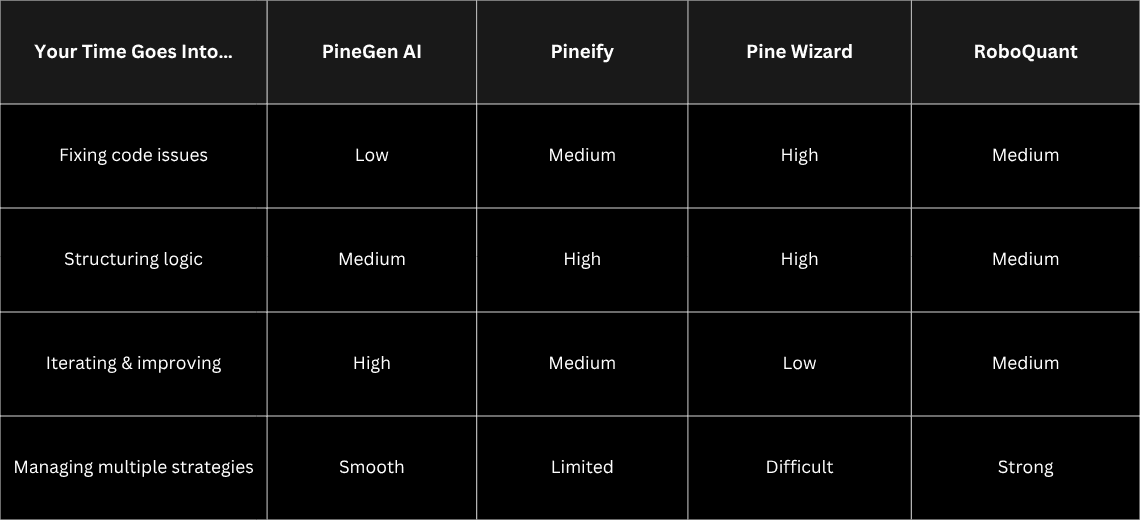
That shift is where most time gets saved.
4. Pineify - Strong Builder, But You Still Control the Logic
Pineify feels smooth right away.
-
clean interface
-
high compilation success
-
visual builder makes things easier
-
It gives a strong first impression.
But after a few iterations, something becomes clear:
It helps you build, but doesn’t enforce how a strategy should behave.
For example:
-
exits depend on how well you define them
-
risk logic isn’t automatically structured
-
multi-timeframe setups can introduce hidden issues
So your workflow becomes:
generate → test → manually refine
It works well if:
you already understand strategy structure
Otherwise:
-
you may get clean code
-
but inconsistent behavior
5. Pine Script Wizard - Fast Start, Slower Progress
This tool is simple.
You type something → you get code instantly.
Great for ideas.
But once you try to turn that into a strategy:
-
exits are often incomplete
-
structure needs fixing
-
debugging becomes manual
So even though generation is fast:
-
the total time to reach something usable increases
-
You spend more time fixing than improving.
6. RoboQuant - Powerful, But Built for a Broader System
RoboQuant operates differently. It’s closer to a full trading platform:
-
supports execution pipelines
-
includes testing environments
-
handles broader workflows
This gives it strength in:
-
structured outputs
-
system-level automation
But:
-
it’s not tightly focused on TradingView behavior
-
heavier to use for quick iteration
Best suited for:
-
advanced setups
-
full system development
7. How This Feels Over Time (Real Workflow Difference)
8. What Most Traders Don’t Expect
From real usage patterns, strategies fail less because of ideas and more because of structure
Common issues:
-
repainting signals
-
weak exit logic
-
unrealistic backtests
These don’t show up immediately.
They show up when you trust the strategy.
9. Final Insight
At a surface level, all tools look similar.
They all generate code.
But once you go deeper, the difference becomes clear:
-
some tools help you write scripts faster
-
some tools help you build strategies properly
10. Conclusion
The real question isn’t:
“Which tool generates better code?”
It’s:
“Which tool helps you take a strategy further?”
Final Takeaway
-
Pine Wizard → quick ideas
-
Pineify → structured building
-
RoboQuant → full systems
But if your goal is:
-
building strategies inside TradingView
-
refining them over time
-
reducing debugging effort
-
scaling multiple ideas
Then PineGen AI fits that workflow more naturally.
If your current process still looks like: generate → fix → test → repeat, you’re spending more time correcting than improving.
With PineGen AI, you can:
-
structure strategies properly from the start
-
iterate without early limits
-
test variations faster
-
improve performance step-by-step
That’s where real progress starts.
Start Building TradingView Strategies with PineGen AI Today
Turn trading ideas into validated strategies with AI